"He must, so know the starfish and the student biologist who sits at the feet of living things, proliferate in all
directions. Having certain tendencies, he must move along their lines to the limit of their potentialities."

John Steinbeck - Log from the Sea of Cortez

Wednesday, June 16, 2010

The art of fish

One of the topics that my fish guys are investigating is the role of our finned friends in art, literature, and popular culture.  Here, Trishonna shares some information about one of the most accomplished fish illustrators out there.

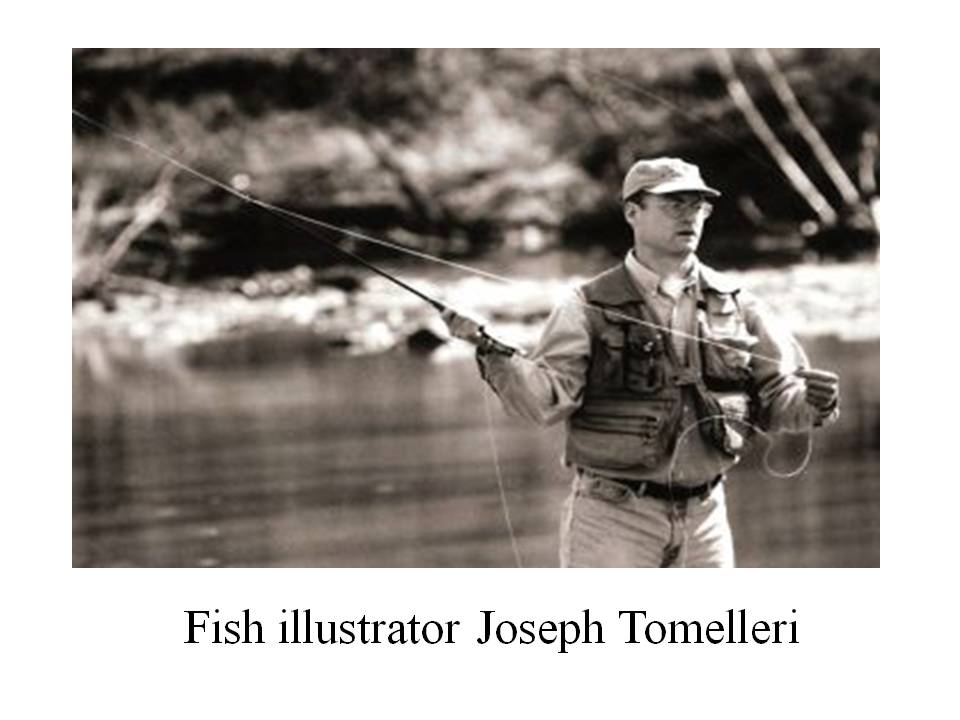
Fish artist Joseph R. Tomelleri was born in Kansas City in 1958. He earned his B.S. and M.S. in Biology from Fort Hays State University in Kansas. Although broadly trained in aquatic biology, he previously worked as a botanist. However, in 1986, Tomelleri turned his full focus towards illustrations of fish. Since that time, he has traveled more than 150,000 miles to collect live fish species for his scientific renderings. Tomelleri has illustrated 800+ species. His drawings are executed in Berol Prismacolor pencil and detailed with graphite. His attention to detail and unparalleled mastery of color, textures and hues has earned him world-wide recognition as a pre-eminent illustrator. His gift is in capturing the details that distinguish the various fish species. This makes Tomelleri’s illustrations of fish very rare, because few artists have the talent to produce drawings that are technically accurate and beautiful as well. He has mastered the skill of illustration. His drawings are done in a manner that is impossible photographically. He captures the fishes faithfully with accurate life colors, scale and fin ray-counts, illustrating a full spread of the fins. He is recognized by many ichthyologists as the finest scientific illustrator of fishes in the world. While in the field, he preferreds to photograph fresh live-caught fish to draw and depict their true life colors. His methods of capturing the specimens included hook-and-line, gill netting, seining, electro-shocking, and trawling. Tomelleri’s art has been featured prominently in more than 350 publications and advertisements. Several of his illustrations were included in a book that he helped co-author with Mark Eberle, Fishes of the Central United States. A compilation of his work was also published in Trout and Salmon of North America, written by Bob Behnke.

Check out Joe Tomelleri's web site here.  And buy something.

Tuesday, June 15, 2010

Fish o' the Day - bowmouth guitarfish

Gradually catching up on processing my students work in their fish class.  Bear with me, guys.

Visitors to the Georgia Aquarium are usually queued up to see the whale sharks.  Personally, I thought the most fascinating fish in the building was this guy.  Contribution from Jason...
 
Located mostly in the shallow waters near coral reefs and mangroves is an odd-looking fish called the bowmouth guitarfish, Rhina ancylostoma. Looking closely at them, they have the appearance of half shark and half ray. The bowmouth guitarfish‘s flat, broad, arc-shaped head spreads into two distinct triangular pectoral fins. The nostrils, mouth, and gill slits are located on the ventral surface of the head and the eyes and large spiracles on the dorsal side. The jaws are heavily ridged with crushing teeth arranged in wave-like rows. Behind the head, the body tapers into a more streamlined shape, much like that of sharks. There are sturdy ridges of heavy, sharp thorns next to the eyes, in the middle of the back, and above the pectoral fins. It has two large, triangular dorsal fins, the second smaller than the first. The body terminates in a small but powerful caudal fin with an upper lobe that is larger than the lower. Dermal denticles cover the body giving the rough skin a velvety appearance.

The color of bowmouth guitarfish changes with age. Young fish have brown bodies, pale ring-shaped spots covering their pectoral fins, and black bars between the eyes. .The body of the adult is charcoal or pale gray body with small white spots. The face bars fade to dark gray with age, becoming faint and indistinct. Some adults have a bluish coloration. The white ventral side in both adult and juvenile phases provides these rays with protective counter-shading.  Bowmouth are viviparous and are aplacental, generally bearing around 4 pups. While they have been known to grow to lengths of 8 feet, most are closer 6.5 or 7 feet. Bowmouths prefer a relatively shallow habitat with a muddy or sandy substrate, and their primary food sources are crustaceans and mollusks. A quick look at their dentition might allow you to deduce that without ever seeing them in action.  Unlike many oceanic species, bowmouths are not cosmopolitan.  Found mostly in waters of Southeast Asia, they do range into the oceans off East African and are also found along the Indian coastline. 
They’re not currently on the IUCN red list, but there’s a push beginning to see that happen. They’re not fished for their meat, but rather for their dorsal fin. – often the living fish is thrown back into the water to die. In addition, bowmouths sometimes become entangled in gill nets due to their odd shape. 

One interesting idea is being kicked around in taxonomic circles. Bowmouths are often described as prehistoric in appearance, and are considered by some to be a ‘missing link’ between sharks and rays. This belief is based on the ray-like placement of the mouth and gill openings and disc shape of the front part of the body and the shark-like streamlined appearance of the rest of the body and the powerful tail. Is this true? Maybe.

The Strand

A highlight of the Subtropical Ecology field trip is our visit to Fakahatchee Strand, the "Amazon of North America," and park biologist Mike Owen.  That's a couple of my guys from a past class - we'll be there again in November.  Enjoy this from the Tuscaloosa News.

Monday, June 14, 2010

FOD...

...should return tomorrow.  I've turned that responsibility over to my students for the duration of the summer.  They meet tomorrow.

In the meantime, how about some night music.  Old Number 7.

Warm-blooded beasts

My fish guys will be talking out thermal relationships tomorrow, and we'll discuss the way in which certain fish like tuna are able to maintain body temperatures considerably higher than ambient.  This gives them a significant advantage in hunting down the other fish on which they feed.  Which makes this new Science paper particularly interesting.  Seems that some of the marine reptiles that were so dominant in Mesozoic seas may have used the same strategy.  The French researchers who led the work employed stable isotopes of oxygen in the phosphates of tooth enamel from fossil ichthyosaurs, plesiosaurs, and mosasaurs.  They compared the ratios to those of fish fossils from the same time period.  Isotope ratios in the poikilothermic fish can be used as a gauge to water temperatures - 18O/16O ratios increase with decreasing water temperature.  The results demonstrated that the body temperature of the aquatic reptiles remained relatively constant, even in changing water temperatures.  The reptiles maintained body temperatures in the neighborhood of 35-39 degrees Celsius, while water temperatures ranged as low as 12 degrees.

No surprise...

...but discouraging nonetheless.  A research vessel from the University of Miami has detected a 23-mile long plume of oil off of Florida's southwestern coast.  The plume is being carried by the Loop Current toward the Dry Tortugas and the Florida Keys.

It would appear...

...that some of my friends in Louisiana are positioning themselves to spend BP's money examining the long-term impacts of the Deepwater Horizon spill.  LSU and the Louisisana Universities Marine Consortium (LUMCON) have signed an MOU with Wood's Hole to form a consortium "to work cooperatively to plan, secure funding for, execute and report on a program of scientific research to describe and quantify the effects of the oil spill...". 

It's a beautifil marriage.  Combining the skills and political clout of WHOI with the regional influence and ideal positioning of the LUMCON facilities should generate some answers about just how much damage has been done to these fragile systems.  The project expects to receive "significant" support from BP. 

Sunday, June 13, 2010

Hot

The last few days have been hot - really hot.  But we've been preparing for that, for a long time.  The thermal hypothesis of human evolution suggests that various aspects of our history, including bidedalism and the loss of fur, could be related to the extremely warm climates that we ultimately hail from.  Of course, for that idea to work we have to assume that our ancestral home was, in fact, hot as Hades.  That was the goal of a study by a group from Johns Hopkins, published recently in PNAS


Lead author Benjamin Passey and his group used a geochemical approach to evaluate past temperatures in the Turkana Basin on Kenya, a region that was home to ancestral hominids for much of our early history.  The group applied istopic analysis to carbonate minerals in the soil, looking specifically at ratios of Carbon-13 and Carbon-18.   This ratio provides a clue to the temperatures at the time of mineral formation.  The analysis revealed daytime temperatures over 90 degree Fahrenheit.  Temperatures such as this make the thermal hypothesis a viable idea.

Thursday, June 10, 2010

Fish Art

One of the "mini-project" assignments that my fish guys will be doing this summer is a look at the role played by fish in art, literature, and popular culture.  More on that tomorrow.  For tonight, check this out.  Samuel Fallours lived, in the early 18th Century, on an island called Amdon in what today is Indonesia what is now Indonesia. He painted fish caught in the local waters, in a region known as the Coral Triangle and famed for the diversity of fish found there.  His catalogue of paintings is one of the world's rarest publications on natural history, but they have been collected in a new book, Tropical Fishes of the East Indies, by Theodore Pietsch.

Fallours had either a keen sense of humor or a great aptitude for marketing.  His paintings were fanciful, in some cases downright imaginary.  He also spun some remarkable tales as back stories.  Read about it here at NewScientist, and enjoy the slide show.

Lots of catching up to do...

...but it's a busy time right now. Some news items tonight, and tomorrow some contributions from the Fish Brigade.

A new offering from Current Biology examines the stereo component of shark olfaction.  It's no secret that sharks can "track" small concentrations of substances (like blood) in the water.  The new research led by Jayne Gardiner at the University of South Florida determines that the fish can sense small delays in the time required to reach one nostril compared to the other.  When they do so, they turn in the direction from which the odor is coming.  This contradicts the long-held notion that directionality was determined by concentration differences - and makes more sense.  The work is summarized here at Science Daily.

Wednesday, June 9, 2010

The fish you live with

And, a piece from Stewart in the Fish as Pets category, looking at the popular betta.

The Siamese fighting fish, or simply fighting fish as it’s commonly referred to in the US, is a fish that comes to us from the rice paddies of Thailand and Cambodia. The species, Betta splendens, earned it’s common name from the fighting behavior exhibited by the males. In nature. the fish are greenish-brown in color - through selective breeding, however, they have be one of the most colorful and sought-after species for freshwater aquaria. The fish typically grow to a length of 2 inches or so, although some varieties can be twice that.  Bettas typically live 2-5 years in captivity.  They belong to the Order Perciformes, which contains nearly 40% of all bony fishes, and are the gourami family (Osphronemidae).  Ahough there are nearly 50 more species in the Betta genus, B. splendens is the most popular species among aquarium hobbyists.

B. splendens has an upturned mouths and is, primarily, a carnivorous surface feeders. In the wild, they feed largely on the larvae of mosquitoes and other insects.  Their reproductive behavior is particularly noteworthy.  To reproduce, the male flares his opercula, spreads his fins, then twists his body when he finds a female of interest.  The female darkens in color and curves her body back and forth. Males build bubble nests on the surface of the water. Then, the “nuptial embrace” takes place as the male wraps his body around the female. Eggs are released from the female as the male releases milt into the water, fertilizing the eggs externally. At this point, the male chases the female out of his territory for fear of her consuming all the eggs as food, and he does the work of retrieving them from the bottom and depositing them into the nest on the surface. Talk about a workout...

A YouTube of spawning bettas...

What fish am I eating?

A contribution from Jake, in the Fish as Food category.

Many people go to restaurants and order fish, but do they really know what type of fish they are ordering? Different restaurants may well use different types of fish.  A popular fish that is being used today for items such as fish sticks and fish patties is the pollock, Theragra chalcogramma. These fish reach lengths to almost four feet and a weight of close to 50 pounds. Recent catches of pollock total close 1.5 million tons per year, representing nearly 1/3 of all marine fish caught annually in U.S. waters. Although the annual catch is large, abundance of pollock is decreasing rapidly due to over-fishing and predators. In 2008, pollock abundance was said to be the lowest in the history of the U.S.-managed fishery.

Even though the pollock numbers are decreasing, the fish is still used today in many well-known restaurants, including Long John Silver’s. Long John Silver’s was founded in 1969 and set trends with the quick-service seafood restaurant.  As the world’s most popular quick-service seafood chain, it has over 1,200 restaurants worldwide.  Although they have not always used them, pollock is the main fish that Long John Silver’s uses today. It is typically served fried, but the restaurant also serves grilled fish, also pollock. 

An endangered Fish o' the Day - pygmy madtom

As I mentioned earlier, I'll be including some posts authored by students in my summer Biology of Fishes course.  Among their other assignments, they're completing weekly "mini-projects" dealing with a number of topics, including Fish o' the Day in different categories (invasive, endangered, etc.), Fish in Art/Literature, Fish as Food, and others.  A couple from last night's session.

An entry from Jason on the endangered pygmy madtom.

The pygmy madtom (Noturus stanauli) is the smallest member of the family Ictaluridae. This family of fish is easily recognized due to the barbels that extend from its upper jaw. The pygmy reaches a total length of only 2 inches. Coloration of the fish is typically a dark brown on the dorsal side and a solid white on the ventral side. It is believed that they have a short life span of approximately one year, but they may spawn multiple times.

Very little is known about the pygmy due to the lack of success in collecting efforts. In the two Tennnessee rivers that they are known to inhabit, successful collection only occurs 25% of the time for the Duck River and 50% of the time for the Clinch River, making this one of the rarest if not the rarest fish in North America.

Where collection efforts have been successful, it is noted that their habitat is a relatively silt-free zone, with a stable substrate, and a very high water quality. This is probably related to the pygmy madtom’s decline. Siltation resulting from environmental changes in the area and degradation of water quality may have diminished the amount of suitable habitat for this species, leading to a struggle to remain viable. It seems that the pygmy could be going the way of the dodo.

One bright note is that the pygmy madtom has been successfully bred in captivity. On a collection effort for other fish, two pygmy madtoms were collected and transported into an aquarium modified for their environment. Two spawning individuals were observed during this time, and 13 offspring were able to reach adulthood. This could lead to reintroduction to areas as long as the habitat is suitable.

One thing to be noted about the pygmy is that, in the areas where it is found, there is always a diverse assemblage of species around it. In the Clinch River, 80 species of fish and 18 federally listed mussels are associated with it pygmy habitat. In the Duck River, 90 species of fish are associated with it. This leads one to believe that the presence of the pygmy madtom is an indicator of a healthier river and ecosystem.

Breaking news...

Flow from BP continues

Tuesday, June 8, 2010

Fish o' the Day - cobia

The last of our coastal fish, for the time being.  Tomorrow, I anticipate having some entries contributed by the students in my summer fish class.  Tonight, we'll look at the cobia, Rachycentron canadum, the only living member of its family, the Rachycentridae.  The genus (and family) name translates roughly to "stinging spines" a reference to the short, stout spines supporting the dorsal fin.  Like a couple of freshwater fish we've seen (the bowfin comes to mind), the cobia is known by many other names to those that encounter it in tropical and temperate waters.  On the Gulf Coast, ling and lemonfish are common nicknames.  Where they're encountered in the Pacific, they may be known as black kingfish or aruan tasek.  Wherever found, they're big, powerful fish, reaching a length of six feet and weighing as much as 100 pounds.  The body is long and sleek, with a flattened head and small eyes.  A chocolate brown dorsal coloration grades to a white belly.  A pair of bands on their sides are more pronounced during the spawning season.  The lower jaw protrudes a bit past the upper jaw, giving them a pugnacious look.  The body shape, along with the large pectoral fins, gives them a distinctly shark-like appearance, and cobia hanging beneath the surface are frequently mistaken for small sharks.

Surprisingly, cobia's closest relatives include the remoras in the Family Echeneidae.  As juveniles, they more closely resemble remoras, although they don't have their characteristic dorsal attachment structure.  Cobia are pelagic fish (making their lack of a swim bladder a little surprising).  They're typically solitary, except when they form spawning aggregations.  They're fond of structure, and can often be found beneath floating objects (debris, seaweed, etc.).  Cobia will feed on a variety of prey, but seem to be particularly fond of swimming crabs.  They're migratory, with a population wintering off south Florida and migrating north in the spring.  They're fished heavily at that time, and the first "ling" of the year is always big news.

Nice video here of a group of cobia.

Monday, June 7, 2010

Worth knowing

BP apparently has enough money in their PR budget to buy sponsored links on major search engines.  Try it out. 

Perhaps that money could be better spent providing some protection from the coastlines currently under assault from their incompetence.  That might be a more appropriate way of dealing with their image.

Sargassum

A nicely done piece from the Mobile Press-Register looking at a fragile, floating, Gulf ecosystem.

Backpedaling

"Well, when I said Autumn, what I meant was..."

Fish o' the Day - hardhead sea catfish

Discussion of surf-fishing in the Panhandle and the common fish along the beaches leads to a consideration of this one - Ariopsis felis. The hardhead belongs to the Family Ariidae, unlike our freshwater catfish in the Family Ictaluridae. The primary difference between the two families? Ictalurids have a set of barbels adjacent to the nostrils - they're lacking in the sea cats. Hardheads are one of the most common fish off our Gulf beaches, and in our bays too, for that matter. At times, it can be difficult to fish with live bait for anything else, because the catfish will have it within seconds of it reaching the bottom. I can't vouch for them as table fare - I've always been told that they weren't any good to eat, although some folks say differently. It certainly wouldn't be a problem to find out. Hardheads can reach a couple of feet in length, and can weigh up to 10 pounds. Considerably smaller is much more common.

They're known as hardheads because of a bone that extends rearward from the head toward the dorsal fin. They should be handled with care - the dorsal and pectoral fins are equipped with very sharp, serrated spines that can go through a glove or a tennis shoe. If they bury one of those in your flesh, the pain is excruciating. This is I can verify from personal experience. An interesting fact - they're mouth-brooders. The male carries the fertilized eggs in his mouth for a month or so prior to hatching.

Sunday, June 6, 2010

And, from Otis Cam..., er, Haley Barbour...

It's not the oil, it's the media. Heck, ah use more oil 'n that on mah franch fries.

Till Autumn?

Admiral Thad Allen, the Coast Guard official in charge of the U.S. response to the BP oil spill, said on a number of news outlets today that the cleanup could last into the Fall. I assume that's just a ridiculously optimistic outlook.

Damn damsels

Until the 1980s, staghorn corals (Acropora sp.) were a dominant member of Caribbean coral reefs. They were hit hard by a variety of diseases, hurricanes, and anthropenic impacts. So hard that they're now endangered. There's been an unforeseen complication. The three-spot damselfish, Stegastes planifrons, kill portions of coral to culture algae and provide hiding spots. They're aggressive, and defend their gardens ferociously. When staghorn corals were abundant, the damselfish preferred to set up housekeeping among their branches, and the relatively fast-growing staghorns could stay ahead of the damage caused by the fish. In the absence of staghorns, damselfish have taken to slower-growing head corals, and they are wreaking havoc on the already stressed corals.

The impact of the damselfish has been recognized for some time, although it was believed that their increase in abundance and impact was the result of a release from predation resulting from overfishing of large fish like groupers. A new paper appearing in PLoS One identifies the changing nature of Caribbean coral reefs as the root of the problem.

Deep reefs at risk

We've heard a lot about the deep plumes of oil and dispersants that are drifting through the Gulf as a result of the Deepwater Horizon disaster (although I suppose that BP is still denying their existence). One ecosystem that may be particularly at risk are the deep-sea coral reefs found in the Gulf and the Florida Straits. In this article at Science Daily, researchers from the University of Miami discuss the threat that the deep plumes represent for these particularly fragile systems. Unlike shallow-water corals, the deep-sea species lack photsynthetic symbionts and are dependent on food particles sinking down from surface waters. If food from the top has to drift through an undersea plume of oil, it will likely be toxic to the deep-dwelling corals. The figure at left, produced by the folks at UM, illustrates the problem.

Night music for a Sunday morning

I wake up with Elizabeth Cook every morning. Of course, she doesn't know anything about it - she's hosting her show on Sirius XM radio and I'm driving to work with my coffee. But still....

A young lady who deserves a lot more attention.

Saturday, June 5, 2010

Seagliders

They're unmanned submersibles that can be equipped with a variety of sensing devices, and they're being deployed in the Gulf to determine whether there are, in fact, vast underwater plumes of oil. Preliminary evidences says there are.

A nice resource...

...from the NY Times.

Tracking the spill

Fish o' the Day - Gulf kingfish

Another Gulf coaster, this one closely associated with sandy beaches. The Gulf kingfish, Menticirrhus littoralis, known commonly along the coast as "whiting", is one of the more common fish in the surf zone on Gulf beaches. Like the spotted seatrout, it's a member of the Family Sciaenidae, the drums. Whiting reach lengths of about 18", and typically weigh a pound or two. There are a couple of other kingfish species that share the same geographic range - the southern kingfish (M. americanus) and the northern kingfish (M. saxatilis) have dark markings on the bodies, while M. littoralis tends to be uniformly silver, with some darker pigmentation on the rear of the caudal fin. All have a single chin barbel. M. littoralis is fond of high energy beaches, while its congeners like calmer areas with softer bottoms.

Whiting apparently spawn offshore in the spring, after which the young fish recruit to the surf zone. They're benthic feeders, taking worms, small bivalves, and other invertebrates. They're a popular fish for surf casters, and one of your most likely catches if you simply take a rod and reel, bait up with a piece of frozen shrimp, and toss it beyond the breakers. That is, if you can avoid all the hardhead catfish long enough for a whiting to find it.

Friday, June 4, 2010

Positive side effects?

Sometimes, all you can do is laugh...


Night music, and the Great American Novel

What's your candidate? I'm sure everyone has their own horse in this race, depending on histories and tastes. My personal list these days has three entries - Moby Dick by Herman Melville, Blood Meridian by Cormac McCarthy, and Shadow Country by Peter Matthiessen. Moby Dick is, of course, a pretty traditional choice. Like most, I was forced to read it in high school. Unlike most, I loved it. I mean, it's about whales. Shadow Country is a recent addition. I read and enjoyed the three books that were blended to form it (Killing Mister Watson being the best known), but the combined, trimmed-down version is, I believe, Matthiessen's masterpiece. The caveat - it deals with the part of the world I love. Again, I'm biased. So, two of my choices must be taken with a grain of salt.

That leaves Cormac McCarthy's brutal masterpiece, which tells the story of the bloodthirsty Glanton gang's forays into Mexico in pursuit of Apache scalps. Quite frankly, Western's aren't my thing - I'm not that guy that seeks out old reruns of Rawhide and has DVD collections of Pale Rider and The Outlaw Josey Wales. Still, I've never read anything as powerful. As American, with all the good and bad things that implies. And Judge Holden is, in my mind, the single most powerful figure in American literature - the only one that compares is Ahab himself. Caution - it's not for the faint-hearted.

So, it pleases me that the lead singer (Ben Nichols) of a favorite band (Lucero) released a solo album built around Blood Meridian. It was an ambitious undertaking, but I think he pulled it off. Here's the opening track.


So, do we believe this?

BP says that the new cap they've placed on their leaking wellhead is capturing 1,000 or so barrels of oil a day. That's a fairly small fraction of the estimated 10,000 - 20,000 barrels thought to be escaping, but the BP officials think that the percentage capture will go up as they close additional vents. The vent closure will be conducted in a way as to minimize the formation of hydrates which would interfere with the operation of the cap.

Here's an animation from BP that explains how the process is supposed to work. Let's just say, I'm not confident.

How to be attacked by a shark

The beaches of Florida's Volusia County, particularly the stretch in and around Daytona Beach and New Smyrna Beach, are fairly infamous for the number of shark attacks that occur there. The vast majority are fairly inconsequential, although lethal attacks are certainly not unheard of. The Florida Museum of Natural History at the University of Florida maintains the International Shark Attack File in which they track shark attack records. Here you can see their compilation of Florida's 629 confirmed, unprovoked shark attacks between 1882 and 2009. Volusia County boasts 239 attacks, more than double the runner-up (which happens to be Brevard County, just to the south of Volusia). It's worth noting that none of the Volusia attacks have been lethal. In fact, only 13 of the total 639 have resulted in fatalities. The reason is that most of the sharks involved, and, in fact, most of the sharks found in nearshore waters are smaller species like spinners, blacktips, blacknoses, etc. You'll get the occasional tiger or bull, but they're few and far between. Still, shark attacks are a serious thing in Florida, where everything depends on tourism and tourism depends on water. And going in the water depends on, well, you know.

So, a group of researchers at UF combined the shark attack statistics with observational data gathered by staking out Volusia County beaches. The goal was to attempt to determine what factors play a role in shark attacks - what is it that makes people victims.

That's a great idea, and I certainly wouldn't put down research of this type. But let's cut through some of the chaff. We find out that most of the attacks are on young, white males, who are attacked most commonly on their legs. And most attacks occur on the weekend. I hope there's a little more analysis coming here. Because, thus far, you've told me that you've got a better chance of being attacked if you go in the water than if you don't.

There's more information, of course, and some of it has value. Attacks are more common in early morning and late afternoon than at mid-day. That may also reflect greater utilization by surfers as a result of higher waves, but it could also tell us something about activity patterns of the fish. Attacks are more likely at new moon and full moon. That could, again, be related to wave patterns and therefore surfing activity. More likely, it has to do with shark activity. Perhaps most intriguing, people wearing black and white swimsuits are attacked more than those wearing other combinations. Now, I haven't looked closely enough to judge whether there are simply more people wearing black and white swimsuits. I don't think that's the case. If it's not, then it suggests that the resulting contrast may make the victim more visible. That's a little troubling, when the prevailing argument for shark attacks in one of mistaken identity.

So, if the idea of being shark bait doesn't appeal to you, put on your green swimsuit and swim on the quarter moon in the middle of the day. And don't be a young white male. Otherwise, you're on your own.

Fish o' the Day - Florida pompano

Another coastal fish that will be seeing some hurt in the coming months. If you've spent much time on Gulf beaches, you've doubtless had juvenile pompano nibbing around your toes. Trachinotus carolinus is a jack, in the Family Carangidae. It's deep-bodied form is different from many of the jacks, which tend to be a bit more streamlined. Pompano also lack the scutes (specialized scales) on the caudal peduncle (the region where the body tapers into the tail) that that are found on most jacks. They're silvery in color, often with a greenish tint on the dorsal surface that trends to yellowish below. They're fond of warmer waters, ranging throughout the Gulf and along the Atlantic Coast from Brazil to Massachusetts. Their occurrence at higher latitudes is a summertime phenomenon. Pompano begin spawning in the Gulf in early spring, and the young individuals start showing up on sandy beaches in April and May. Late in the fall, the fish will move out into deeper water. The juveniles feed on small invertebrates, like amphipods, copepods, and larval forms of other crustaceans. As they grow, they begin feeding on larger inverts like mole crabs and coquina. Although they can reach lengths of almost two feet and weights of 8 pounds, a 2-3 pound pompano is a nice one.

Pompano grow rapidly, reaching lengths of about 8" in a year. They mature rapidly, at a year or two, and their entire lifespan is only 3-4 years. This attribute, coupled with their tolerance of a wide range of environmental conditions, has made them an attractive candidate for aquaculture. These prospects are being investigated in a number of locations, notably at Mote Marine Lab.

Of course, pompano aquaculture wouldn't have much of a future if it weren't for the fact that they're an excellent food fish. They're the hero of a lot of dishes, the most notable probably being the Pompano en Papillote made famous at Antoine's in New Orleans. While we'll admit to eating a few, we like them when they're still in the water too.

Thursday, June 3, 2010

How not to stop the leak.

Let me count the ways.

From the coast...

Some CNN videos detailing various aspects of the disaster.

Something that BP would probably rather not think about...


And, from Acme Oyster House...


The president says he's furious. I think it's time to let a little of that fury show.

And the Florida coastline

We had discussed a camping/fishing trip to Big Lagoon State Park - an attempt to get one last coast trip in prior to everything changing. It appears that we may have waited too long.

Florida

Those of you that have been reading SKTS for a while know that the content is largely driven by the classes that I'm teaching at the time. Thus far, there's been a lot of fish (that'll continue), a lot of evolutionary biology (ditto), with liberal doses of conservation biology, vertebrate zoology and assorted other items. This fall, I'll be offering my class in Subtropical Ecology, where my intrepid band of explorers and I investigate habitats around the state of Florida, ranging from longleaf pine forests and pitcher plant bogs in the north to mangrove forests and coral reefs in the Florida Keys. So, that content will be coming. Here's an early offering.

Florida is characterized by a series of ridges, like the Trail Ridge, that run from north to south down the peninsula. These ridges bear abundant marine fossils in their sandy deposits. A new study out of Gainesville indicates that the marine nature of these elevated ridges results from isostatic rise of the land, rather than elevated sea levels. The peninsula, and its ridges, have risen as the result of the lowered density of crust deposits as acidic waters dissolve some of the limestone making them up. As the crust lightens, it's lifted by the mantle beneath. That's till going on, at a rate of about .05 mm per year. Unfortunately, that's not enough of an increase to keep up with rising sea levels, estimated at about 3 mm per year. Enjoy your waterfront property while you can.

A very, very old river

It's not really biology, but it's certainly related. Plus, I'm fascinated by rivers and I don't think I'm alone in that. Anyway, new mineral analyses reveal China's Yangtze River to be 45 million years old, about 40 million years older than had been previously thought.

That motivates me to do a little looking into the Yangtze's fish fauna. I don't know that much about it, with the exception of the almost mythical Chinese paddlefish - which might well be extinct. Future FOD.

How many species?

A basic question, for which we still don't have a good answer. Lately, we've seen numbers like 30 million thrown around routinely as a possibility. A new study appearing in American Naturalist suggests the number is likely considerably lower than that. The sticking point is in our knowledge of tropical arthropods, which without question make up the lion's share of remaining, undescribed species. Previous studies have suggested that there might be tens of millions of unknown insect species in the tropics. The new study, led by Andrew Hamilton from the University of Melbourne, uses applied probability modeling to estimate, to estimate that there is a 90% likelihood that there are between 2 and 7 million tropical arthropods, with the estimate centering at 3.7 million. After throwing in reasonable estimates for undescribed species in other groups (and ignoring the bacteria, which are something of a taxonomic black hole right now), they come up with a best estimate of about 5.5 million species on the planet. That's a heckuva lot less than most of the estimates we've seen over the last couple of decades. The new estimate still means, however, that some 70% of arthropods remain unknown.

Whale evolution

Just how fast was the early evolution of whales? The diversity of the group is fairly remarkable - almost 100 existing species of a wide range of sizes and filling a range of niches. A great many fossil species that have come and gone. All living forms are descended from a common ancestor that lived relatively recently, about 35 million years ago. The perception is that whales must have hit on a big new idea, evolutionarily speaking, that triggered an evolutionary explosion. Is that actually the case? A new paper coming out of UCLA and appearing online at Proceedings of the Royal Society B explores this question.

Employing a variety of computational and molecular techniques, the researchers demonstrate that whales, early in their evolution, had begun to diverge along different lines. This is clear from an examination of the size and trophic habits of early whales. Early on, small whales feeding on fish, moderately-sized whales feeding on squid, and large, plankton-feeding whales were already present 25 million years ago, and that triumvirate of whale niches exists largely unchanged today. There are exceptions, of course, Killer whales, somewhat unique in their preference for feeding on other mammals, have only evolved their large size within the last 10 million years or so.

Fish o' the Day - spotted seatrout

With the oil beginning to wash up on the shores of Dauphin Island, and friends and students reporting a slick less than 10 miles off the Pensacola beaches, it seems appropriate to spend a couple of FODs paying tribute to some of the great fish of the Gulf Coast. Quite honestly, fish have always been a big part of the coast experience. I'm afraid that won't the the same for a while.

A long time ago (about 35 years ago, if you must know), my friends and I spent a few remarkable summers wade-fishing the seagrass beds of Santa Rosa Sound in search of spotted seatrout, or "specks", as everyone along the coast knows them. The first day that I stumbled on our "honey-hole", I waded out in waist deep water and started casting a top-water lure over a dense Thalassia bed. About ten casts later, I was landing a gator speck that would have pushed 10 pounds. Through that summer and the next, we caught a lot of really beautiful fish. Then, very suddenly it seemed, they were gone. Hours of fishing would produce only a couple of smallish fish. We blamed the gill-netters that had descended on the same waters in numbers, and there was probably some truth to that argument. Certainly, the fish seemed to have made a bit of a comeback since Florida's ban on gill-netting passed in 1994. Now this. I fear they'll be a long time coming back.

The spotted seatrout, Cynoscion nebulosus, is not a trout at all, but a member of the Family Sciaenidae. That's the drums, the family that contains the redfish and the Atlantic croaker. They're sleaker and more streamlined than most of the drums, actually bearing a superficial resemblance to the trout and salmon. One of their most distinctive features is the pair of large, canine teeth at the front of the upper jaw. The body is silvery, with many small dark spots over over the upper part of the back and extending onto the fins. Unlike many of the drums, there are no chin barbels. They can reach lengths of 3 feet weigh and can weigh over 15 pounds, but a 3-pound speck is a nice one. Juveniles feed primarily on small crustaceans, while the adults take small fish and shrimp.

Seatrout reach maturity from 1-4 years of age, depending on sex and location, and spawn in coastal waters and estuaries. They're a classic example of a fish that depends on estuaries, seagrass meadows, and salt marshes as nursery habitats. They're reasonably tolerant of a wide range of environmental conditions - I guess we're about to find out how tolerant they are of oil.

Wednesday, June 2, 2010

Dino buddy

The first dinosaurs appear in the fossil record about 230 million years ago, showing up in South America and Madagascar fauna around the same time. They coexisted with a number of other reptile groups for perhaps 30 million years before rising to dominance at the close of the Triassic Period about 200 million years.

Among the reptilian groups that bumped shoulders with the budding dinosaurs during this time were the aetosaurs, a group of Triassic herbivores armored with heavy bony plates. The early aetosaurs were fairly small - less than a meter - but some of the later forms got quite large. They included Typothorax, which has been known from fragmentary New Mexico fossils for over 100 years. A new paper in the Journal of Vertebrate Paleontology (summarized here at Science Daily) describes two new, very complete fossils that have shed new light on this animal, one of the last of the large herbivores that existed prior to the rise of the dinosaurs.

The new specimens, representing a species known as Typothorax coccinarum, reveal an animal about 2.5 meters in length, half that of the largest aetosaurs. They were completely encased in bony armor, even down to the overlapping plates that ran down the legs onto the feet. They were quadrupeds, but the front half of the body was considerably lighter and more delicate than the rear. The front legs splayed out to the side of the body, while the hind legs were held beneath the body pillar-like. Their anatomy suggests that might have fed by grubbing in the soil in much the same fashion as modern-day armadillos. In fact, Dr. Andy Heckert, one of the study's authors suggests that T. coccinarum looks like an animal "designed by a committee combining a cow with a crocodile and an armadillo."

Fish o' the Day - bluegill

How mundane is that? Bluegill? Still, I'm always surprised at the number of people that been familiar with this fish since they were kids, but still know relatively little about it. In fact, a significant percentage don't even know that it's a bluegill.

Round these parts, people regularly go "brim" fishing (actually, they go brim fishin', if you want to know the truth). You might occasionally find someone who spells it "bream" - might even be a little uppity about it. You'll even find quite a few folks who refer to them as perch, although perch are in a completely different family.

Why all the confusion? It's probably attributable to the diversity of the group to which they belong, a little heritage, and a little laziness on the part of the general public. Bluegill are in the Family Centrarchidae, one of 18 centrarchids in Alabama alone. Of those, 11 are considered to be "sunfish" the relatively small, deep-bodied members of the genera Lepomis and Ambloplites. Back in the day, a trip to the creek with your cane pool and a can of worms might yield several species that looked enough alike to be all lumped together as "brim". This term likely owes its origins to a group of European cyprinids belonging to the genus Abramis and known colloquially as bream, to which the sunfish bear a superficial resemblance. It's likely that settlers in the American South simply christened the fish they caught in their streams and rivers with a familiar moniker.

Nominal confusion aside, the bluegill (Lepomis macrochirus) is quite a fish. It's the sunfish of choice, the one that is typically stocked in ponds and lakes, and, probably, the first fish caught in the lifetime of most Americans. That's a pretty significant honor, fishly speaking. They're native to most of the eastern U.S., and have been widely transplanted. The common name comes from a characteristic blue edging on the gill rakers. The species epithet, macrochirus, means "large hand", and is probably a reference to their characteristic size. In fact, bluegill anglers often refer to bringing home a string of "hand-sized" fish. They get larger - the world record, taken from an Alabama lake, is close to 5 pounds.

Bluegill have figured heavily in some significant ecological research, including optimal foraging studies examining prey utilization. Small individuals are usually plankton-feeders, filtering small prey from the water using long, delicate gill rakers. As the fish mature, they move to a diet of insects and their larvae. And, of course, they're fond of worms.

Tuesday, June 1, 2010

Forgotten?

So, what about the non-commercial species in the Gulf? Well, don't be surprised if they slip through the cracks of this nightmare. A case in point...

The largetooth sawfish, Pristis perotteti, native to the tropical Atlantic, was known from the northwestern Gulf but has not been encountered there in years. In May, just a few weeks after the Deepwater Horizon disaster, P. perotteti was proposed for federal endangered species status, a protection already afforded to its sister species, the smalltooth sawfish (P. pectinata). The smalltooth sawfish remaining in the U.S. are confined largely to coastal waters of the lower peninsula of Florida.

Given the benthic nature of sawfish and their dependence on crustaceans and mollusks, they will doubtless suffer a heavy blow as oil impacts coastal estuaries.

On a related front...

...NOAA has added Gulf waters showing areas of oil sheen to those previously closed to fishing. This brings the total closed area to 60,683 square miles, about 25% of the federal waters in the Gulf of Mexico.

And, if you're a fisherman and would like to contact BP regarding a claim - DIAL 1-800-440-0858.

Next...

After the well-publicized failure of top-kill, BP has a whole 'nother idea. Now we can all sleep soundly.

Their crack response team of Larry, Curly, and Moe now plan to attack the leak on three fronts. First, after pumping some 30,000 barrels of mud into the well in an attempt to block the flow of oil, BP engineers will reverse the approach. They will use equipment and pipes already present, but will instead try to carry the oil to surface and capture it. In addition, plans are underway to saw through the pipe below failed blow-out preventer (BOP) to allow the installation of a cap that will sit atop the BOP and direct oil into a pipe to the surface. Finally, BP is moving forward with the last-resort solution of relief wells that will reduce pressure at the wellhead and allow the installation of an additional BOP on top of the first.

BP is "confident it will succeed." So, there you go - nothing to worry about.

Monday, May 31, 2010

Tale of two tuna

A new paper appearing at PLoS One compares the spawning habitat of bluefin and yellowfin tuna in the Gulf of Mexico, and finds bluefins to have much more specific requirements than their yellow-finned cousins. Researchers used accidental bycatch reports as well as tracking data to determine that bluefin move into the Gulf in the spring months and seek out specific areas - notably continental slope regions in both the northeastern and northwestern Gulf. Yellowfin, on the other hand, are present in the Gulf throughout the year and show much more generalized habitat preferences.

There's bad news here for bluefin. The species is already in trouble - they were considered for endangered status this Spring. The region of the Gulf that they seek out, right about this time of year, also happens to be the region impacted by the Deepwater Horizon spill.

Sunday, May 30, 2010

Break's over

Classes start on Tuesday for what will be a hectic summer session. So, I'll be back to a routine and should be posting more regularly. Good break with some time for family, and some time to recharge. Now, it's time to go back to work.

Friday, May 28, 2010

Another plume

Researchers from USF have found what they believe to be a large, subsurface plume of oil. Six miles wide and as deep as 3,300 feet. This one is stretching toward the northwest, toward Mobile and Dauphin Island.

Wednesday, May 26, 2010

Grolar bears

A second hybrid bear has been killed on sea ice in the Northwest Territories. Tests have revealed that this one is a second-generation hybrid, the offspring of a female grizzly-polar bear hybrid and a male grizzly bear. It's believed that such hybrids will become more common as climate change forces grizzlies into more northern climates, and disappearing sea ice forces polar bears onto the mainland.

New species

Very cool stuff here. The Top 10 new species described in 2009 from the International Institute for Species Exploration at Arizona State. Three new fish species - the psychedelic frogfish, the dracula minnow, and Omar's banded knifefish. Can't make this up.

Tuesday, May 25, 2010

Cladoceran fashions

Nice look at a morphological response to predation pressure in Daphnia in Swedish lakes. Water fleas studied in the lakes in the Orekilsalven River basin show two very different types of responses. In lakes in the upper reaches of the system, female Daphnia have relatively large bodies topped by a fairly small "cap" (an anterior extension of the carapace). Those found further down the river system show reduced body size, but a larger cap.

Hans Lord from the Department of Zoology at University of Gothenburg thinks that the different morphologies are an indication of the ostracods response to a widening suite of predators. The larger cap makes the cladocerns harder for invertebrate predators to manipulate. Smaller body size, on the other hand, makes the animals less visible to sight-feeding fish. The cap, being transparent, gives protection against invertebrate predators without making them more visible to fish.

Male Daphnia don't show the same morphology - no cap. This is likely due to different selective pressures. Males need to be able to find females and mate quickly. A big cap gets in the way.

In females, the large caps are a summertime phenomenon. This could be the result of different types of predatory pressures with changing seasons, or it may refect the greater viscosity of cold water. Can't swim through thick water wearing a big hat.

Monday, May 24, 2010

Fish o' the Day - Gulf sturgeon

Watched an episode of "River Monsters" this afternoon that I had DVR'd while I was at the coast. Jeremy, breathless as always, was tracking down a lake monster in Alaska. After eliminating other possibilities, he decided to travel to the Columbia River to catch a white sturgeon to prove the identify of the Alaskan beast. OK, Jeremy's an entertainer, not a scientist. Still, his mention of the jumping Gulf sturgeon suggested tonight's FOD. Gulf sturgeon, Acipenser oxyrhynchus desotoi, are appearing in increasing numbers as they migrate up Gulf Coast rivers. It's become enough of an issue that the Florida Fish and Wildlife Conservation Commission recently issued an advisory suggesting that boaters slow down on the Suwannee River to avoid collisions with airborne sturgeon.

The Gulf sturgeon was recognized as a subspecies about 50 years ago. It's virtually indistinguishable from the Atlantic sturgeon (A. oxyrhynchus oxyrhynchus) - apparently you have to dissect them and measure the spleen. Gulf sturgeon are listed as threatened, with critical habitat including Florida's Suwannee, Apalachicola, Choctawhatchee, and Escambia Rivers, as well as the Pascagoula and Pearl Rivers in Mississippi. They're big fish, reaching 8 feet and 200 pounds. Gulf sturgeon are anadramous, spending part of the year coastal marine habitats and returning to rivers in spawning migrations. While in the Gulf, sturgeon apparently remain over seagrass beds or shallow muddy bottoms near shore. In the spring, they move upriver, spawning near the headwaters, and then spend the summer months in deep river water or near spring mouths. rs, returning to estuarine or gulf waters during the coolest months of the year. Sub-adult fish also participate in this migration. During the warm summer months, gulf sturgeon congregate in the deeper sandy and rocky bottom areas of rivers as well as near the mouths of springs. Interestingly, they seem to do most, if not all, of their feeding during the winter months when they are in coastal habitats. There, they feed on a variety of benthic animals including mollusks, crustaceans, and worms.

The reasons for jumping are unclear, although it's speculated that it may allow individuals to maintain contact with another. It's also been suggested that it may allow them to rid themselves of ectoparasites.

A brief video of a jumping Suwannee sturgeon....


Sunday, May 23, 2010

A double dip of night music...

...and another history lesson. Jackson Browne then, and now. Actually, I had his hair in the 70s. Not any more.


Pretty sure I've used that line, too. "Don't confront me with me my failures..."

Time stops for no man. Do it now.

Can it get any more desperate?

They say that lessons learned at great expense are learned best. This one should stick with us a while. What say you, Ms. Palin?

BP's last shot?


Thanks to Adam Zyglis at The Buffalo News

School lessons

Schools of fish, that is. A major problem with the development of "wind farms" for the harvesting of wind energy is the availability of space. Traditional horizontal-axis turbines have big propellors and must be spaced far apart to avoid interference. Newer vertical-axis turbines use a vertical rotor and more may be placed in a smaller array. Graduate students at the California Institute of Technology have determined that the placement of such vertical turbines in specific arrays may yield significantly higher energy gains by taking advantage of the manner in which air moves through the array. Their model - schools of fish. The vortices created by fish moving in a school can be used to understand how one turbine may influence those around it. The Cal Tech researchers believe that the application of these principles may result in a ten-fold increase in the wind energy that can be generated from a given area.

New strategy

Sit in the sun, warm up your body, and drive the ladies mad. Well, it works for damselflies. New research in Behavioral Ecology and Sociobiology indicates that damselflies with warmer bodies have greater mating success. Female preference for the hot guys is apparently driven by the prospect of a warmer territory in which to lay eggs, leading to greater reproductive success.

Saturday, May 22, 2010

Friday, May 21, 2010

Night music

Music has a unique ability to take you back to a certain time and place. This song certainly does. The memories have taken a beating, but the message still resonates.


Fishing strategies

Been reading/hearing Callum Roberts' An Unnatural History of the Sea, which documents the millenium-long history of our overexploitation of marine resources. Which makes this new paper in PNAS more intruiging. It suggests that we may be using the wrong model. The buzz-phrase these days is "ecosystem-based fisheries management", an approach designed to minimize the impact of fishing on marine ecosystems. The prevailing line of thought in such fisheries has been to employ highly selective methods that remove only certain species of specific sizes. The new work from a group of authors led by Shijie Zhou of CSIRO suggests that less selective methods might actually have lower impact. Zhou suggests that "production could actually increase through the better use of non-target species, while reducing unsustainably high catches of target species...".

More hammerheads

Currently, the hammerhead sharks are represented by eight (or nine, depends on who you listen to) species in the Family Sphyrnidae. Although all of them have the characteristic "cepahalofoil", the distinctive, flattened head from which the group draws its name, they show a lot of diversity in both size and in the shape of the head. The bonnethead (Sphyrna tiburo) reaches lengths of about a meter and has a fairly narrow, spade-shaped cephalofoil. The great hammerhead (Sphyrna mokarran), on the other end of the spectrum, sports the classic "hammer" and can reach 6 meters in length. New research appearing in Molecular Phylogenetics and Systematics describes work done by researchers at the University of Colorado and the University of South Florida employing DNA analysis to analyze the family tree of the hammerheads. The researchers used both mitochondrial (4 genes) and nuclear DNA (3 genes) in their examination of the evolutionary history of the group. They discovered that the ancestral hammerhead appeared relatively suddenly some 20 million years ago. It was a big fish, comparable to the larger of the living species. Small size apparently evolved twice in the development of today's smaller sharks. The cepahalofoil has been strongly acted upon by natural selection to create divergence in the lineages leading to modern hammerheads.

Fish o' the Day - Southern stingray

It's proving difficult to get back into a routine. Lots of news items sitting here on my desk, but still feeling residual laziness. Not gonna worry about it too much - summer semester will be here soon enough. For now, the return of FOD.

Spent quite a bit of time wade-fishing Santa Rosa Sound last week, and saw plenty of stingrays. They're almost like alligators in the Everglades - very impressive to see such a high density of a large predator. Dasyatis americana is widely distributed through the tropical and temperate Atlantic and in the Gulf and the Caribbean. They can be big, reaching a "wingspan" of as much as 6 feet. A really big one may push 200 pounds in weight. Their claim to fame, of course, is the "sting" or barb, which is a modified denticle found about a third of the way down the long, whip-like tail. Grooves on the barb carry a proteinaceous poison which can certainly cause some problems for someone unfortunate enough to be "stung." It's rare, however, as stingrays will usually do whatever they can to avoid a confrontation. The most dangerous situation occurs when a wader or snorkeler steps on or swims over a partially buried stingray in shallow water. The toxin can be partially denatured by hot water, and this is a fairly effective first aid prior to a visit to the doctor.

Southern stingrays feed primarily on crabs and mollusks, although they'll take an occasional small fish if they can get one. They're ovoviviparous, meaning that they give birth to live young. After the smaller male impregnates the female, the eggs hatch out internally. The female then gives birth to five or so young rays.

On Monday, I kept an eye on a good-sized ray, perhaps three feet across, that shared with me the sandy edge of a Santa Rosa Sound seagrass bed in about two feet of water. I assume she was keeping an eye on me as well, and eventually she took flight into the deeper waters of the Sound.

Wednesday, May 19, 2010

OK, back at it...

...after a much-needed break with a very unique, very special family. Plan to crash tonight, and then start doing some catching up tomorrow.

I confess to complete confusion regarding the Deepwater Horizon mess. The Florida panhandle, as of today, has yet to see landfall. But there's a tremendous amount of oil out there, and it going to wind up on someone's marshes, beaches, reefs, etc. Right now, we're in that nasty mode of thinking - send it somewhere else. We see the same line of thought with hurricanes, at least since the devastation of the last decade reminded Gulf Coast residents that a hurricane is not a reason to party. This spill is different - there's a sense of dread all up and down the coast, and we'll no doubt all suffer. I'm currently thinking about my friends in the Keys who are dependent on healthy reefs. It appears likely that the Florida Loop Current will take a significant amount of oil their way. There are few ecological systems more fragile. I guess it's appropriate to say, "Hope for the best." I'm just not sure what the best is right now.

There were a few unusual aspects of beach life this week, but I want to do a little background work before getting into them.

See you tomorrow.